
Germany: Part One
If you’ve stumbled onto this page, while it says part one above, it’s just part one of a trip to Germany, however it’s also part five of a series of blog posts chronicling my solo journey through Europe to the places my ancestors came from. You can start here to get caught up.
May 4, 2026
After two days of detours in Belgium and Luxembourg, I was excited to get to another ancestral town, and to finally get to Germany – the place I’d been wanting to visit for over 30 years, and a place where I had a better understanding of the language. While reading through my dad’s family tree research, I learned that the ancestors who started in Gorenflos, France, immigrated to Friedrichsthal, Germany in the late 1600s. I looked up the town and it was right on my way from Luxembourg to Freiburg im Breisgau, a little town in southern Germany that kept popping up as picturesque town to visit. Spoiler alert: I later learned that this was the wrong Friedrichsthal, but I didn’t know that yet while I was visiting it.
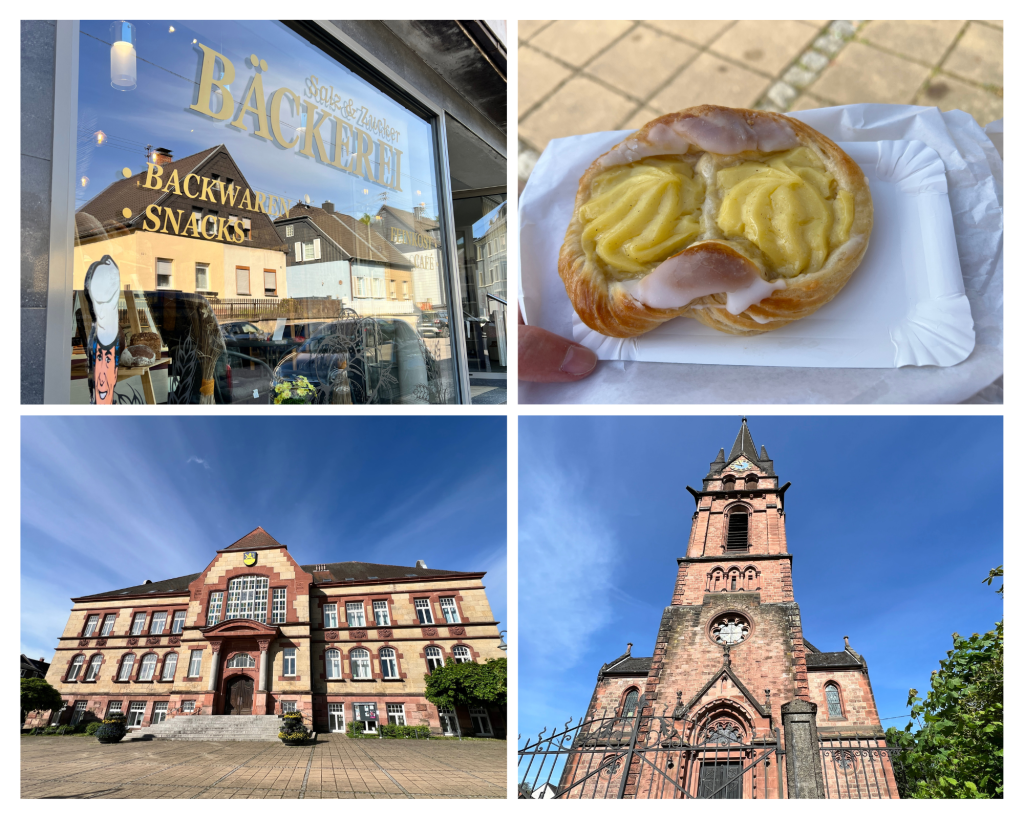
I had found a bakery in Friedrichsthal with good reviews, and was looking forward to ordering a pastry and sitting down with a coffee. But, I walked in and saw that there was only one small table in the window which looked more like decoration and not quite inviting. So, I placed my order to go instead, and found a public bench outside to sit and eat.
I was parked in a grocery store parking lot, and wasn’t 100% sure I was allowed to be there since I wasn’t a customer. One thing I knew in my research about driving in Germany is that when there’s free 2-hour street parking, you’re supposed to place a little paper clock on the dash of your car showing what time you got there, called a Parkscheibe. I needed gas anyway, so that was my next quest. I was pretty proud of myself for figuring out how to pump the gas on my own, and went inside to pay. I meant to ask the attendant if they had a Parkscheibe, but I couldn’t remember the word. Instead I asked, “do you have the clock for parking the car?”, but they were sold out. I decided I wouldn’t bother tracking one down, and instead would just stick to regular paid parking garages.
Friedrichsthal was a lot bigger than I had imagined, but also it honestly seemed a little bit of a run-down town. But I drove around a little bit and happened upon a gorgeous old church. As I walked around taking pictures of the church, I noticed a man across the street in his yard. I walked over and asked if he knew the history of the church. He started speaking so quickly, but I managed to pick up “ask the woman” and “office” while he pointed to a small house next door to the church. So, I walked over there and rang the bell.
A woman answered, and again I asked if she knew the history of the church. She told me to wait a moment, and then she went and got a man who came out. I asked one more time, but again he was speaking so quickly I couldn’t really understand what he was saying. I explained that I only understood a little bit of German, told him I was visiting the town because my ancestors lived there hundreds of years ago, and asked if he knew when the church was built. He said it was built in the late 1800s, so I knew it was more recent than when my ancestors had lived there (well, again, they didn’t actually live there, but I digress). He ended up giving me a little book about the church that I will need to spend some time translating later.
I left Friedrichsthal a little bit disappointed that the city wasn’t cuter, but really proud of myself for having all of those conversations without speaking a word of English. I got back on the road and three hours later I made it to Freiburg im Breisgau, which thankfully was oozing with cute.
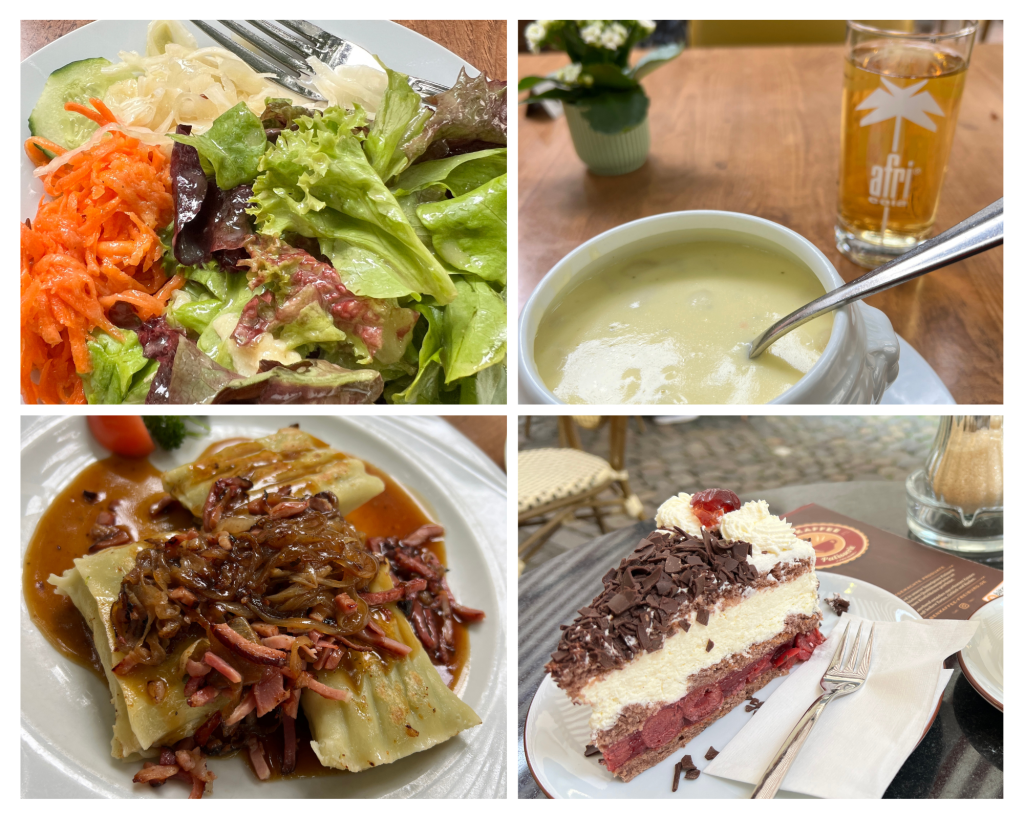
My first stop in town was for lunch at Sichelschmiede, where I enjoyed an Apfelschorle, a popular German drink that’s essentially sparkling apple juice, Spargelsuppe, or cream of white asparagus soup, and Maultaschen, minced-meat filled dumplings topped with caramelized onions and bacon. I also had a little side salad that tasted like deconstructed coleslaw, and overall this was one of my favorite meals on my whole trip. It was more food than I could eat, so I wasn’t particularly hungry for dinner, and instead I participated in a German tradition of “coffee and cake time”. I’m typically not a cake person, but if I figured when in the Black Forest, I should eat some Black Forest Cake, and I got my fix at Kolben Kaffee.
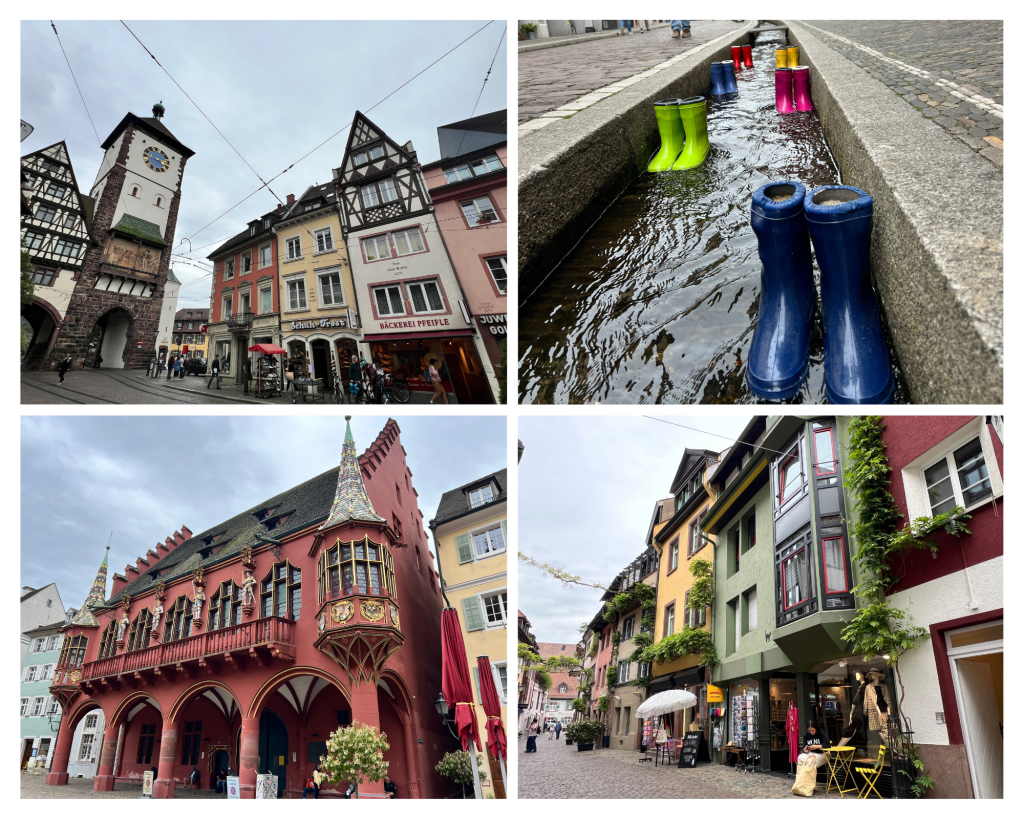
This was another day where I didn’t really have an agenda or specific list of sights to see, and instead just had fun wandering down the cobbled streets looking at all the half-timbered buildings. Freiburg is unique in that it has a bunch of tiny, narrow canals, and I saw quite a few street vendors selling little boats for kids to play with in the canals. It was a pretty quiet day since it was the off-season, but I imagined the town coming to life in the summer, full of people strolling with ice cream while they’re in town to hike through the Black Forest. I must have blended in well as a local, because as I was walking back to my car, an older man stopped and asked me, in German, “is the church behind this building?”, and I was able to tell him that yes, yes it was.
I made my way to my hotel, which was a basic Holiday Inn Express in Ringsheim. The only interesting thing in the area near my hotel was the Europa-Park amusement park, which I assume is the reason my hotel was full of a bunch of German teenagers on a field trip. There wasn’t anything noteworthy for me to say about the hotel itself, but I’d be remiss not to bring up the really disorienting experience of having your hotel fire alarm go off in the middle of the night in a foreign country. Though I couldn’t really understand most of the German announcement accompanying the alarm, common sense took over and I pretty quickly realized what was happening. The fire department showed up, and after about 30 minutes we were all let back inside. I never did figure out what exactly happened, but I’m assuming it was a false alarm.
may 5, 2026
The next morning, my first stop was Freudenstadt, a popular spa town which literally translates to “city of joy”. To get there, I had to drive along narrow, winding roads through the Black Forest, which was so much fun but also a little scarier (more so than driving on the Authobahn, which I’ll get to later). I had remembered reading in my dad’s ancestry research that my 10th-great-grandpa died in Freudenstadt. It has the largest market square in all of Germany, so I was surprised by how quiet it was when I arrived – maybe just because it was early in the morning on a week day, I’m not sure. I popped into the tourist information center and found an English brochure. Here, I learned that the French army completely destroyed the city by fire only a few weeks before the end of World War II. Like much of Germany, they did a great job building the city back up while keeping the historic architecture. As a means of reconciliation, in 1961 Freudenstadt became sister cities with the French town of Courbevoie, and there is a park with memorials dedicated to this. I also had another encounter where someone asked me for directions in German. This time, I only understood the word “behind”, and when I asked if she could speak slower or in English, she just gave up and walked away.
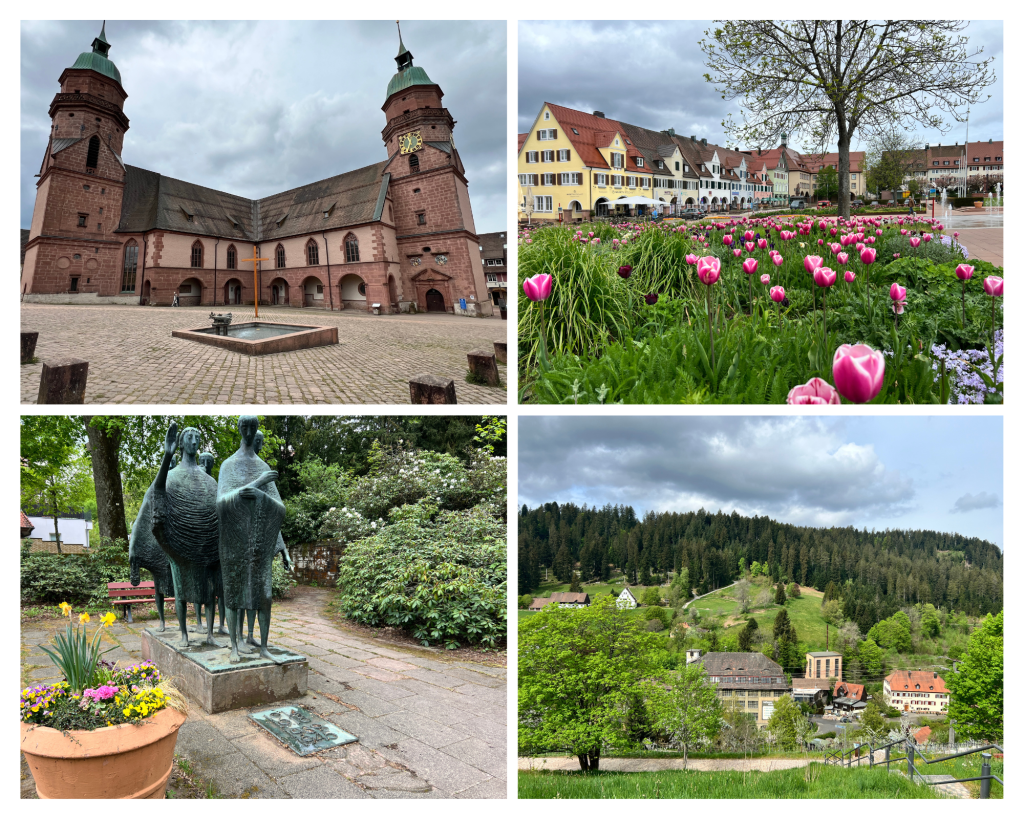
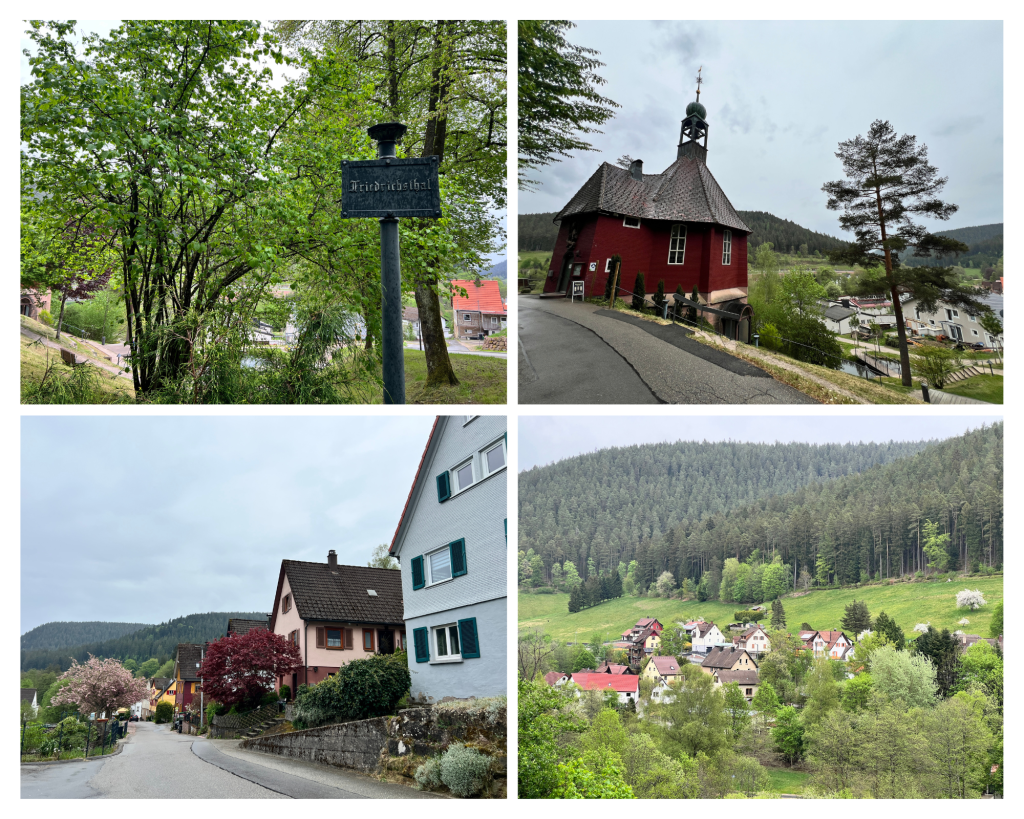
While wandering around, I found a lookout point over a little valley, and I enjoyed spending some time just staring out at it, it was so quiet and peaceful, with only the sound of chirping birds. There was a walking trail through the valley, and while I didn’t walk that far along it, it was there that I noticed a sign pointing to the town of Friedrichsthal, only 4km away. I knew this didn’t line up with the Friedrichsthal I had visited the day before, so I went back to the family history paperwork and this is where I noticed it mentioned “Friedrichsthal, Freudenstadt” as one location rather than two separate towns, so I finally made my way over to the correct town where my ancestors immigrated after fleeing France.
Now in the correct Friedrichsthal, I found a cute little church. This was built after my ancestors immigrated to the U.S., but I popped in anyway to take a look around. There was also a small park, a few homes, and a factory. The only people I saw around were busy working at the factory, so unlike the wrong Friedtrichsthal, I chose not to bother them and didn’t attempt to talk to anyone. Had someone been just wandering around, I would have liked to ask if they knew of any Gorenflos still living in the area (from my dad’s research, I know some very distance cousins were still there as of 1980). While there wasn’t much to the town, I’m so glad I found it on accident, and I loved it so much more than the wrong town.
From Friedrichsthal, I drove what should have been about 3 hours to Rothenburg ob der Tauber, a medieval town that kept popping up as a must-visit place. The German Autobahn is known for not having a speed limit, though honestly there are large chunks of it that do have a limit of 130kmh, or about 80mph. During my drives, there was quite a bit of traffic and road construction that made it impossible to go fast, but I did manage one stretch of getting up to 160kmh, or 100mph, just to say I did. I only did that for about a minute before I slowed back down to 130kmh. My drive to Rothenburg though was a continual downpour of rain, which left all of us crawling along. Thankfully the rain cleared up just as I pulled into the city, so I was still able to enjoy a nice evening out.
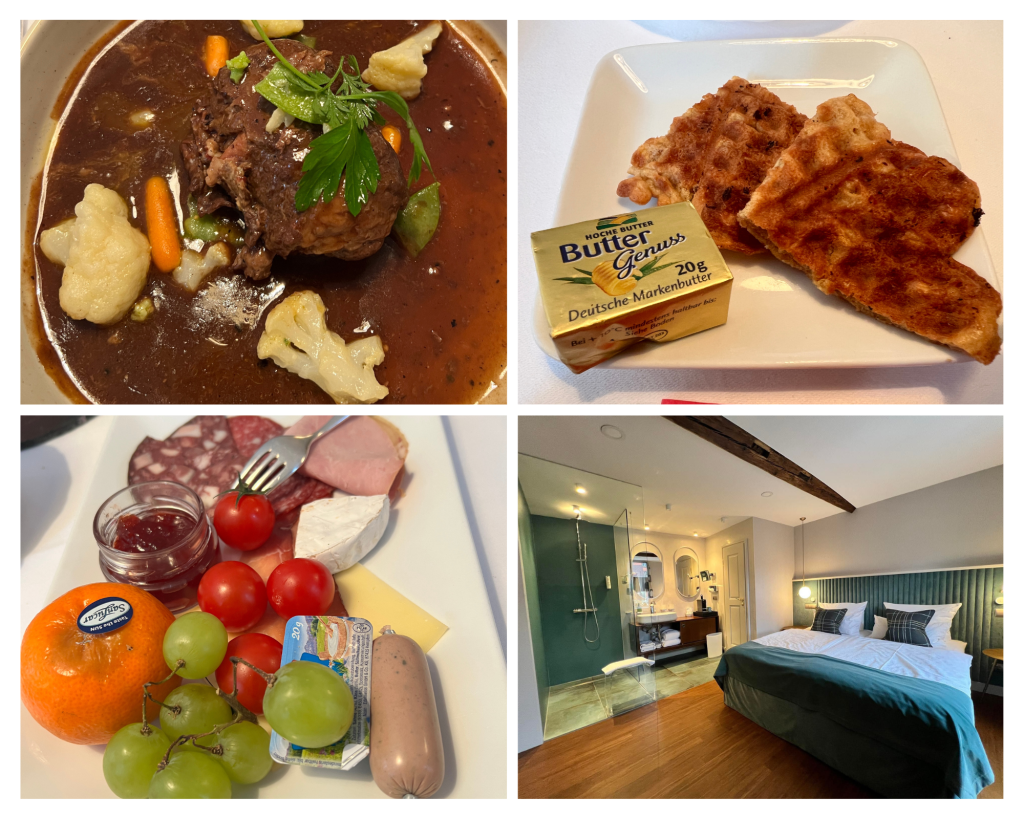
One thing I kept reading over and over was that I had to do the Nightwatchman Tour in Rothenburg, which starts every day, all year, at 8pm. I had just enough time to eat dinner before the tour started, but I didn’t have time to wander around and decide where to eat. I had a list of a few options that I found while researching the trip, but none of them sounded good in the moment. I was staying at the Romatik Hotel Markusturm, which has a restaurant attached, so for convenience I ate dinner there. I had the Rouladen, or rolled beef, and it was delicious (as was my Brotzeit, or “bread time” breakfast the following morning). The room was incredibly gorgeous, and I felt like I was living in a fairy tale. The hotel is just a block outside the old town marketplace, and I’d definitely recommend it to everyone, but with one caveat: I don’t know how all the rooms are, but mine had a glass shower with no privacy to the rest of the room, which made me glad I was traveling solo.
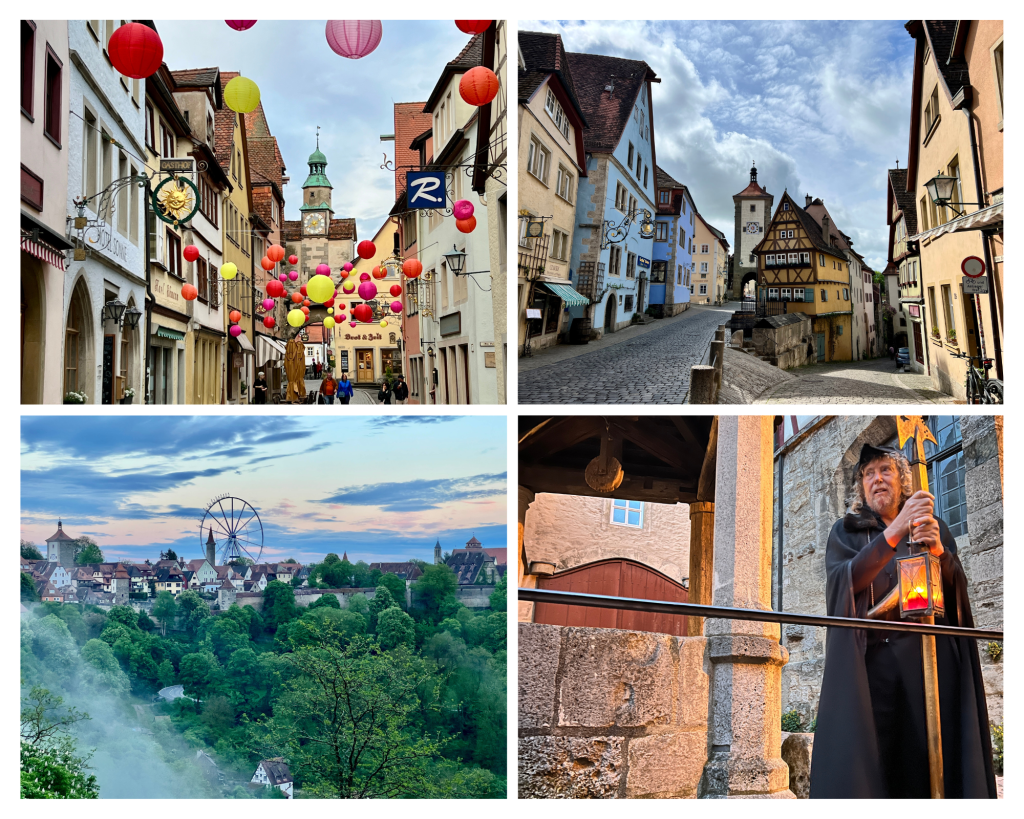
The Nightwatchman Tour was so much fun, and it’s free, but you’re expected to tip at the end, so bring some Euros in cash. They offer two tours per day, one in English and one in German. The night watchmen used to light the lanterns at dusk and, of course, keep watch at night for both fires and criminals. The guide dressed up in character and took us around town, giving the history of the city. It’s built up on a cliff over the Tauber river (which is where it’s name comes from, literally Red Castle Over The Tauber), which provides natural protection and still has an intact city wall surrounding it, which you can walk along. The city fell victim to the bubonic plague, the 30 Years War, and World War II, yet still stands today.
may 6, 2026
The next morning, I went back out to see everything by day. I started at the clock tower, which tells the legend of how the town mayor saved the city by winning a bet and drinking a barrel of beer. I walked by St. Jacob’s church, which has a corner carved out with a sculpture depicting Jesus in the Garden of Gethsemane. I wandered along the city wall and through the streets, including one that supposedly inspired the town in Pinocchio. Rothenburg is also home to one of the first Christmas markets, and I imagine it’s quite a busy scene in December. There is a Christmas history museum which I would have loved to see, but it wasn’t open when I was there. However, there was a whole Christmas store that’s open year-round, and this time I couldn’t choose just one ornament and ended up with three.
Around midday, I decided I had seen most of the city and I was ready to get back on the road and head to my next stop, Munich.


Leave a comment